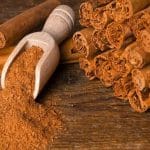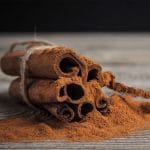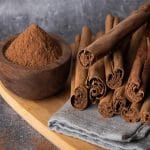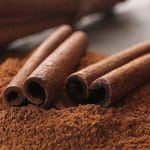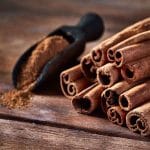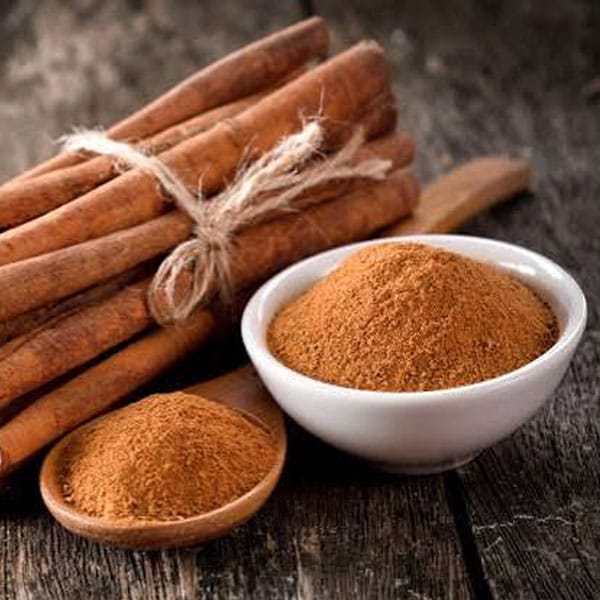
Cinnamon is not one spice. It is the inner bark of several different trees in the genus Cinnamomum, and the difference between them is not a matter of grade or preference. It is a matter of which species you were actually sold.
Cinnamomum verum — Ceylon cinnamon, named for the island now called Sri Lanka — is what botanists and traders call true cinnamon. Most of the cinnamon in world commerce is not it. Four other species are sold under the same word, and they are more correctly called cassia: C. cassia from China, C. burmannii from Indonesia, C. loureiroi from Vietnam, and the uncommon C. citriodorum. World production in 2023 came to 238,403 tonnes, led by China with 39 per cent of it. Four countries — China, Vietnam, Indonesia and Sri Lanka — accounted for 98 per cent between them.
The difference you can measure
Cassia contains coumarin, a fragrant compound that Ceylon cinnamon has almost none of. The gap is not subtle and the ranges do not overlap:
- Ceylon cinnamon, C. verum: 0.005 to 0.090 mg of coumarin per gram
- Chinese cassia, C. cassia: 1.74 to 7.67 mg per gram
- Indonesian or Padang cassia, C. burmannii: 2.14 to 9.30 mg per gram
- Saigon or Vietnamese cassia, C. loureiroi: 1.06 to 6.97 mg per gram
The German Federal Institute for Risk Assessment sets a tolerable daily intake of 0.1 mg of coumarin per kilogram of body weight, and calculates that a single teaspoon of cassia powder carries 5.8 to 12.1 mg — enough to exceed that figure for a smaller person. The same institute states plainly that Ceylon cinnamon contains “hardly any” coumarin, and is equally plain that a higher intake for a short time is not dangerous. No adverse effect has been directly measured in humans, and the United States Occupational Safety and Health Administration does not classify coumarin as a human carcinogen. This is a reason to know which species is in the jar, not a reason to be afraid of a bun.
Which is why the label is the problem
Europe regulates the compound rather than the species. Regulation (EC) No 1334/2008 caps coumarin at 50 mg/kg in traditional or seasonal bakery goods that mention cinnamon on the label, 20 mg/kg in breakfast cereals, 15 mg/kg in other fine bakery ware and 5 mg/kg in desserts.
And the labels do not always hold. Analysis of authentic Ceylon bark found 12 to 143 mg/kg of coumarin. Market samples sold as Ceylon ran as high as 3,462 mg/kg — twenty-four times the top of the authentic range, which points to cassia mixed in. A 2020 review by ConsumerLab found the same pattern, and noted that the supplement carrying the most coumarin of all was the one labelled Ceylon cinnamon.
That is the whole provenance question in one spice. The two barks look similar, cost differently, and one of them is being sold as the other.