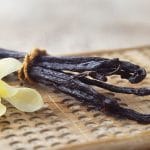
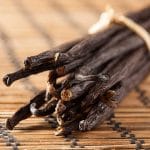
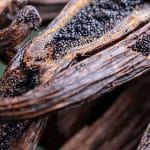
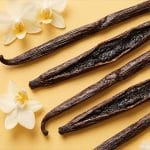
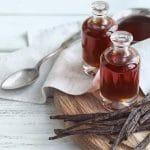
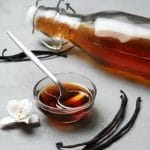
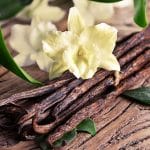
Vanilla is the cured seed pod of Vanilla planifolia, a climbing orchid domesticated in Mesoamerica and now grown across the tropics. It is the only orchid cultivated for food, and it is the only major spice whose entire world supply depends on a task no machine has ever been able to do.
The orchid is not self-pollinating. In its native range a small number of insects manage the job, and even there a wild vanilla flower has roughly a one-in-a-hundred chance of being pollinated. Everywhere else there is no pollinator at all. So every flower, on every farm, is opened by hand with a sliver of bamboo and pollinated by a worker who has to reach it within twelve hours of it opening — because the flower lasts about a day, sometimes less. One flower per stem opens per day. A plantation has to be walked and inspected every single morning of the flowering season.
That method is not ancient. It was worked out in 1841 by Edmond Albius, a twelve-year-old enslaved child on the French island of Réunion, and it is the reason vanilla could be grown anywhere outside Mexico at all. A Belgian botanist, Charles François Antoine Morren, had pollinated the plant artificially four years earlier, but his method was too costly to use commercially. Albius’s was not, and within sixty years the Indian Ocean islands were producing four fifths of the world’s vanilla.
What it costs, and why that number moves so violently
After pollination the pod takes five to six weeks to form and around six months to mature, and then months more of curing — killing, sweating, slow-drying, conditioning — before it smells of anything at all. A vine does not produce until its third or fourth year and stays productive for twelve to fourteen. Nothing about that chain can be hurried, and none of it can be scaled up quickly when the price rises.
So the price does not adjust. It lurches. The unit value of Madagascar’s vanilla exports was $72.97 a kilogram in 2015. Cyclone Enawo tore through the growing region in 2017 and it reached $456.53 by 2018 — more than six times, in three years. By 2024 the same figure had fallen to $50.86. A farmer who planted in the spike harvested into the collapse.
Almost none of the vanilla you taste is this
Roughly ninety-five per cent of products flavoured “vanilla” use vanillin synthesised from lignin, a by-product of wood pulp, rather than anything grown. That is not a scandal; it is arithmetic. World production of raw vanilla was 7,433 tonnes in 2023 — Madagascar 42 per cent of it, Indonesia 25 — against a global appetite for vanilla flavour that no orchid crop could meet.
Which makes the pod itself a provenance question rather than a flavour question. When you buy vanilla, the thing you are paying for is the hand that opened the flower.