Many beginners search the market for saffron seeds, but the plant behind the world’s most expensive spice actually relies entirely on vegetative reproduction through underground corms. Understanding this biological quirk is the first crucial step to successfully cultivating or sourcing real Crocus sativus. At Origin & Source, we decode these botanical realities to help growers and buyers make informed, scam-free, and confident agricultural decisions.
Saffron at a Glance: Key Facts for Buyers & Businesses
| Category | Details |
|---|---|
| Botanical Name | Crocus sativus L. |
| Primary Origins | Iran (90%), Afghanistan, Spain, Kashmir (India), Greece |
| Active Compounds | Crocin (color), Picrocrocin (flavor), Safranal (aroma) |
| Grading Standards | ISO 3632 (Category I–III based on crocin, picrocrocin, safranal levels) |
| Common Grades | Sargol (all-red threads), Negin (premium long threads), Pushal (red + some yellow) |
| Retail Price Range (2026) | 8– 15/gram (premium), 500 – 500– 3,000/kg (bulk, B2B) |
| Key Quality Indicators | Deep red color, minimal yellow threads, strong aroma, moisture <12%, no additives |
| Shelf Life | 2–3 years (airtight, cool, dark storage) |
| Culinary Uses | Paella, risotto, Persian rice, desserts, teas |
| Health Benefits | Antioxidant, mood support, potential anti-inflammatory properties* |
| Buying Tips for Consumers | Buy threads (not powder), check ISO cert, test 2–3 threads in warm water |
| Sourcing Tips for Businesses | Request lab reports (ISO 3632), verify origin docs, sample before bulk orders |
Saffron at a Glance: Key Facts for Buyers & Businesses. Origin, grades, 2026 prices, and purity checks — the essentials for both home and bulk saffron buyers, in one table. Columns: Category, Details. Botanical Name — Crocus sativus L.. Primary Origins — Iran (90%), Afghanistan, Spain, Kashmir (India), Greece. Active Compounds — Crocin (color), Picrocrocin (flavor), Safranal (aroma). Grading Standards — ISO 3632 (Category I–III based on crocin, picrocrocin, safranal levels). Common Grades — Sargol (all-red threads), Negin (premium long threads), Pushal (red + some yellow). Retail Price Range (2026) — 8– 15/gram (premium), 500 – 500– 3,000/kg (bulk, B2B). Key Quality Indicators — Deep red color, minimal yellow threads, strong aroma, moisture <12%, no additives. Shelf Life — 2–3 years (airtight, cool, dark storage).
If you have ever tried to start your own spice garden, you have likely browsed online marketplaces looking for “saffron seeds.” You might have even found listings boasting high germination rates and beautiful photos of the famous purple flower. However, as product sourcing and botanical experts, we have to share a hard truth: authentic saffron seeds do not exist.
The true saffron plant, Crocus sativus, is a botanical anomaly. It is completely sterile and incapable of producing viable seeds. So, how has a plant that cannot naturally reproduce survived for thousands of years to become the most sought-after spice on earth? The answer lies entirely beneath the soil, in a specialized structure known as a corm.
The Biological Reality: Why Saffron Doesn’t Have Seeds
To understand why you cannot buy saffron seeds, you have to look at the plant’s genetics. Crocus sativus is a triploid plant. This means it has three sets of chromosomes instead of the usual two. Because chromosomes need to pair up evenly during the reproductive process (meiosis) to create fertile seeds, the odd number of chromosomes in the saffron crocus disrupts this process.
The flowers produce pollen, and they possess stigmas (the red threads we harvest as saffron), but if you attempt to pollinate them, nothing happens. The plant is trapped in an evolutionary dead end. Without human intervention, the saffron crocus would have gone extinct centuries ago.
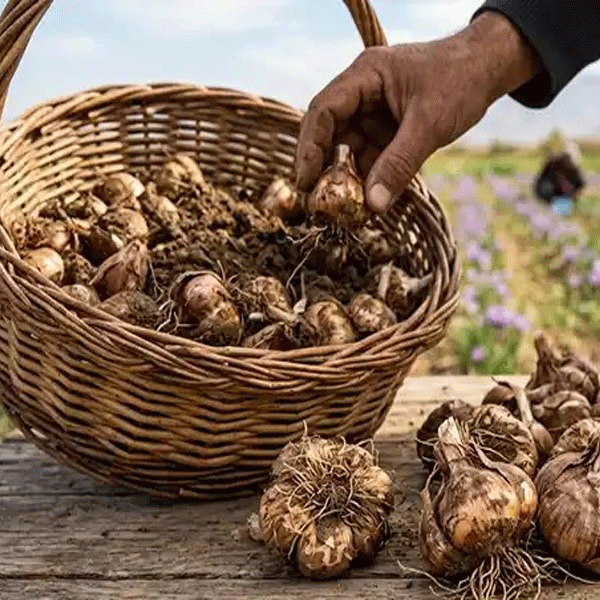
Saffron corms
Enter the Corm: Saffron’s Lifeline
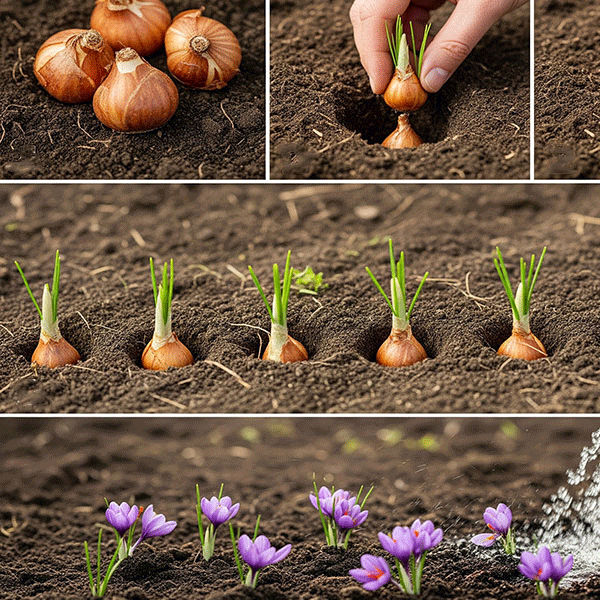
Since it cannot drop seeds, saffron relies entirely on vegetative multiplication. The plant grows from a corm, which is essentially a swollen, underground plant stem that stores food to help the plant survive harsh conditions and fuel its rapid autumn growth.
While corms are often casually referred to as “bulbs,” they are botanically distinct. A bulb (like an onion) is made of fleshy leaves in layers, whereas a corm is a solid, starchy base covered by a papery tunic.
How the reproduction cycle works:
Planting: A mature “mother” corm is planted in late summer.
Blooming: In mid-autumn, the corm utilizes its stored energy to push up grass-like leaves and the famous purple flowers.
Multiplication: Throughout the winter and spring, the mother corm dedicates all its energy to creating clones of itself. By early summer, the mother corm completely withers away and dies, leaving behind a cluster of 1 to 10 smaller “daughter” corms in its place.
Dormancy: These daughter corms go dormant during the hot summer months, ready to be dug up, separated, and replanted to repeat the cycle.
Saffron Culture and Facts: Discover the ancient origins, botanical mysteries, and cultural legacy behind the world’s most expensive spice.
The “Saffron Seed” Scam: What Are You Actually Buying?
| Feature | True Saffron Corms (Crocus sativus) | Fake “Saffron Seeds” (Usually Safflower) |
|---|---|---|
| Botanical Nature | Solid underground stem (clone) | Fertilized embryo (seed) |
| Culinary Value | Produces authentic, premium saffron threads | Zero culinary value; often used as a dye |
| Growth Timeline | Blooms in 4-8 weeks after late-summer planting | Takes months to mature, blooms in summer |
| Reproduction Speed | Slow (Multiplies by dividing underground yearly) | Fast (Produces hundreds of seeds per flower) |
Sourcing Saffron Corms: A Buyer’s Checklist
If you are serious about growing your own supply or sourcing stock for agricultural purposes, you must buy dormant corms during their resting period (usually July through early September).
When evaluating suppliers, pay close attention to corm grading. The size of the corm directly dictates your harvest. Corms are graded by their circumference in centimeters. A corm that is 7-8 cm will likely produce one flower in its first year. Premium corms, sized 9-10 cm or even 11+ cm, have the stored energy to produce up to three flowers each in their first season, offering an immediate return on your investment. Furthermore, always ensure the supplier provides phytosanitary certificates to guarantee the corms are free from fungal diseases like corm rot, which can decimate an entire crop.
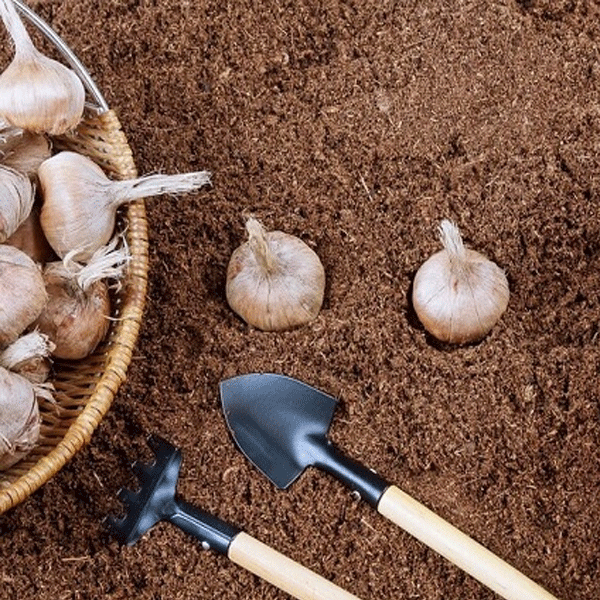
Saffron corms
The survival of Crocus sativus is a fascinating testament to human agriculture. Because the plant cannot produce seeds, every single strand of authentic saffron you have ever consumed comes from a plant that was hand-divided and replanted by a farmer, continuing a genetic lineage that stretches back thousands of years. This labor-intensive multiplication process is a major factor in why saffron commands such a high price on the global market.
By understanding that saffron exclusively reproduces through corms, you immediately protect yourself from deceptive market practices. Whether you are a hobbyist looking to grow a few pots on your balcony, or a buyer analyzing the supply chain of this luxurious spice, knowing exactly how the plant propagates ensures you are investing your time and money into the authentic, highly prized Crocus sativus.
Records mentioned in this article
Frequently Asked Questions
No. The authentic saffron plant (Crocus sativus) is a sterile triploid and does not produce viable seeds. It can only be grown by planting underground corms. Products marketed as “saffron seeds” are typically safflower or toxic autumn crocus.
A single healthy mother corm will usually produce between 3 to 10 smaller daughter corms over the course of a single growing season. After the mother corm dies, these daughter corms are dug up during summer dormancy and replanted to expand the crop.
While both are underground storage organs, a bulb (like garlic or tulips) consists of fleshy, layered leaves. A corm (like saffron or gladiolus) is a solid, swollen stem base covered by a dry, papery outer skin called a tunic.