Cardamom price per kilogram
US$17.53 per kg
Customs value of traded shipments, 2024. This is a bulk, border-crossing figure — not a shop price.
A newer period, 2025, currently stands at $26.51 per kilogram — but on far less volume than recent periods, which is what a period still being filed looks like. It is left out of the headline until the rest of it arrives.
Some figures in this series were not filed by the exporting country itself. They are built by the United Nations from what that country's trading partners declared importing — a sound method, and still not the same thing as a customs return.
The same price, by the weight you buy in
And in other currencies, per kilogram
The same dollar figure at European Central Bank reference rates, refreshed 1 hour ago. These are conversions of one number, not separate readings of each local market.
Check a quote
Enter a price exactly as it was given to you — any currency, any weight — and it is put into the same terms as the figure above so the two can be compared.
That is — the traded value of US$17.53 per kilogram shown above.
That price could not be converted. Either the currency has no reference rate on this site, or the result falls outside the range this catalogue treats as plausible. Nothing is guessed in either case.
The series behind that figure
- UN Comtrade Trade statistics 090831, country 320
How to read these numbers
A customs value is an average
It is the total declared value of shipments divided by their total declared weight. Every grade in that period is inside it — the finest and the ordinary, averaged together. A specific grade can sit well above or below it and nothing is wrong.
It is an origin-side figure
The price at the border of the exporting country, before freight, duty, importing, packing and retail. Comparing it against a supermarket shelf is comparing two different points in a chain, not two prices for the same thing.
The date matters more than the number
Countries file trade statistics after the fact, so the newest published period is usually months old. The period is printed beside every figure on this page, and one that has aged past its window is marked rather than quietly presented as current.
A price far below the reference is a question
Not proof of anything. But a quote well under what the goods cost to cross a border usually means a difference in grade, in weight, or in what is actually in the bag — and it is worth asking which before it is worth celebrating.
Where this comes from
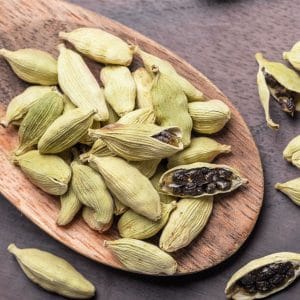 Origin record
Cardamom
Cardamom is the dried fruit capsule of Elettaria cardamomum, a plant whose native range Kew records as south-west India alone. It is the third most expensive…
Read the record
Origin record
Cardamom
Cardamom is the dried fruit capsule of Elettaria cardamomum, a plant whose native range Kew records as south-west India alone. It is the third most expensive…
Read the record
Frequently asked
How much does Cardamom cost per kilogram?
The figure at the top of this page is the customs value of real shipments — total declared value divided by total declared weight, for the period named beside it. It is what the goods were worth crossing a border in bulk, which is the closest thing to a market price that is published at all. A shop shelf sits well above it.
Why is the shop price so much higher than this?
Because this is a bulk export figure. Between it and a jar sit freight, duty, importer and distributor margins, packing, retail margin and tax — and at retail you are buying grams rather than tonnes. A multiple of five or ten is ordinary rather than suspicious.
Which exchange rate does the converter use?
The European Central Bank daily reference rates, refreshed twice a day, and the page says how long ago that was. A currency the rates do not cover is refused rather than approximated, so any figure shown here is one this page can stand behind.
How current are these figures?
The period is printed beside every figure, and one that has not been refreshed recently is marked as such rather than presented as today. Customs statistics are inherently months behind: countries file after the fact, and some file late or not at all.
Is a quote I have been given for Cardamom reasonable?
Put it into the converter and read the multiple it prints. A quote near the traded value is a bulk, origin-side price; several times higher is normal once the goods have been imported, packed and put on a shelf. A quote far below the traded value deserves a question about grade, weight, and what exactly is in the bag.
Trade figures are published by national customs authorities and collated by the United Nations Comtrade database; exchange rates are the European Central Bank daily reference rates. Both are averages of real transactions, which makes them the right tool for judging whether a quote is sensible and the wrong tool for settling a contract.